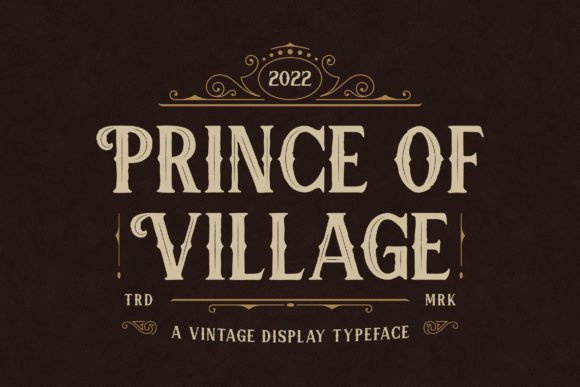
Prince of Village: A Vintage Serif Font for Timeless Branding
Last Tuesday, I spent three hours reworking the label for my small-batch lavender honey jars — tweaking spacing, adjusting size, swapping fonts — until something finally clicked. That “something” was Prince of Village. As a vintage serif font, it brought instant warmth and quiet confidence to a design that had felt flat for months. If you’re running a café, candle studio, boutique, or handmade shop, you know how much a single typeface can shape how people feel before they even taste, smell, or touch your product. Prince of Village isn’t flashy — it’s thoughtful, grounded, and effortlessly elegant.
Prince of Village for Coffee Shop Menus and Daily Signage
My neighbor’s neighborhood café just swapped their digital menu board and chalkboard specials to Prince of Village, and customers started commenting — not on the coffee (though it’s great), but on how “cozy” and “real” the signage feels. As a serif font, Prince of Village adds subtle texture and personality without sacrificing legibility at arm’s length. It works beautifully for daily specials written in chalk-style mockups, laminated countertop menus, and even small vinyl lettering on reclaimed wood signs. Because it’s a display-focused serif font, it shines best in larger sizes — think headings, section dividers, and featured item names — while staying crisp and friendly even on matte paper or weathered metal.
Prince of Village for Vintage Restaurant Branding and Letterhead
When my friend launched her supper club out of a converted 1920s storefront, she knew her brand needed to whisper history — not shout it. She used Prince of Village across everything: embossed letterhead, reservation cards, weekly newsletter headers, and even the tiny “Est. 2024” stamp beside her logo. As a vintage serif font, Prince of Village carries that gentle gravitas — like ink pressed into linen paper — without looking costumed or dated. It pairs naturally with soft cream stock, muted olive greens, and hand-drawn botanical accents. And because it’s a commercial font licensed for print and digital use, she didn’t worry about permissions when printing 500 welcome postcards or uploading branded PDFs to her booking site.
How Prince of Village Works on Labels and Product Packaging
I tested Prince of Village on three real packaging formats: a 2 oz candle jar label (1.75" tall), a folded bakery box flap (2.5" wide), and a reusable cotton tote tag (1.25" x 1.25"). On all three, it held up beautifully — especially when set at 14–18 pt with generous letter spacing. As a serif font, its slight contrast and open counters keep text readable even on curved surfaces or textured kraft paper. Just avoid using it below 10 pt for fine print — save that for a clean sans serif companion. For labels, Prince of Village is ideal for brand names, flavor titles (“Honey Lavender,” “Salted Caramel”), and short descriptors — never long ingredient lists or legal disclaimers.
Prince of Village for Posters, Badges, and Local Event Graphics
Last month, our town’s indie bookstore asked me to design their summer reading challenge poster. They wanted “literary but welcoming,” not academic or stiff. Prince of Village became the hero typeface for the headline (“Read Your Way Through Summer”) and badge-style icons (“Finish 3 Books → Get 15% Off”). As a versatile serif font, it balances authority and approachability — perfect for community-facing materials where trust and charm matter equally. It also scales well: same font file worked for a 24"x36" printed poster, an Instagram Story graphic, and a 2"x2" enamel pin mockup. Bonus? Its natural rhythm makes short phrases feel intentional, not hurried.
Pairing Prince of Village With Other Fonts for Balanced Branding
Here’s what I learned after testing a dozen pairings: Prince of Village loves quiet contrast. Try it with a warm, neutral sans serif like Montserrat Light or Poppins Regular for body copy, email footers, or web navigation. Or go softer — pair it with a delicate script font (like “Dancing Script” or “Allison”) for wedding invites or artisanal gift tags. As a serif font, Prince of Village anchors the design; the supporting font should step back, not compete. Avoid heavy black weights or ultra-thin scripts underneath it — let the vintage serif font breathe and lead.
Prince of Village for Newsletters, Social Media Banners, and Digital Ads
I added Prince of Village to my Canva brand kit last week — and immediately updated my Instagram highlights cover, Pinterest banner, and monthly newsletter header. As a display serif font, it catches attention in thumbnails without screaming. It reads clearly on mobile screens at 20–24 pt, especially against solid-color or softly blurred backgrounds. One tip: export social graphics as PNGs (not JPEGs) to preserve its subtle serifs and ink-like weight transitions. And yes — Prince of Village is a fully licensed commercial font, so you can use it freely in ads, Etsy shop banners, Shopify homepage sliders, and client presentations — no hidden restrictions.
Using Prince of Village for Logos and Headings With Confidence
Your logo is often the first thing people see — and the last thing they remember. That’s why I chose Prince of Village for my own logo lockup (just the wordmark, no icon). Its balanced proportions, gentle stroke modulation, and classic serif structure make it feel both distinctive and dependable. As a serif font, it conveys care and craftsmanship — ideal for makers, bakers, florists, and wellness brands. Use it for headlines on landing pages, podcast episode titles, or even embroidered patches. Just remember: Prince of Village is designed for impact, not paragraphs. Keep it for short, meaningful text — your name, your promise, your moment.
If you’ve ever stared at a blank Canva template, refreshed a Shopify theme for the fifth time, or wondered why your new candle line doesn’t “feel” cohesive yet — sometimes the answer isn’t more tools or trends. It’s one thoughtful choice: a vintage serif font like Prince of Village, ready to bring consistency, character, and quiet confidence to every piece of your brand.